
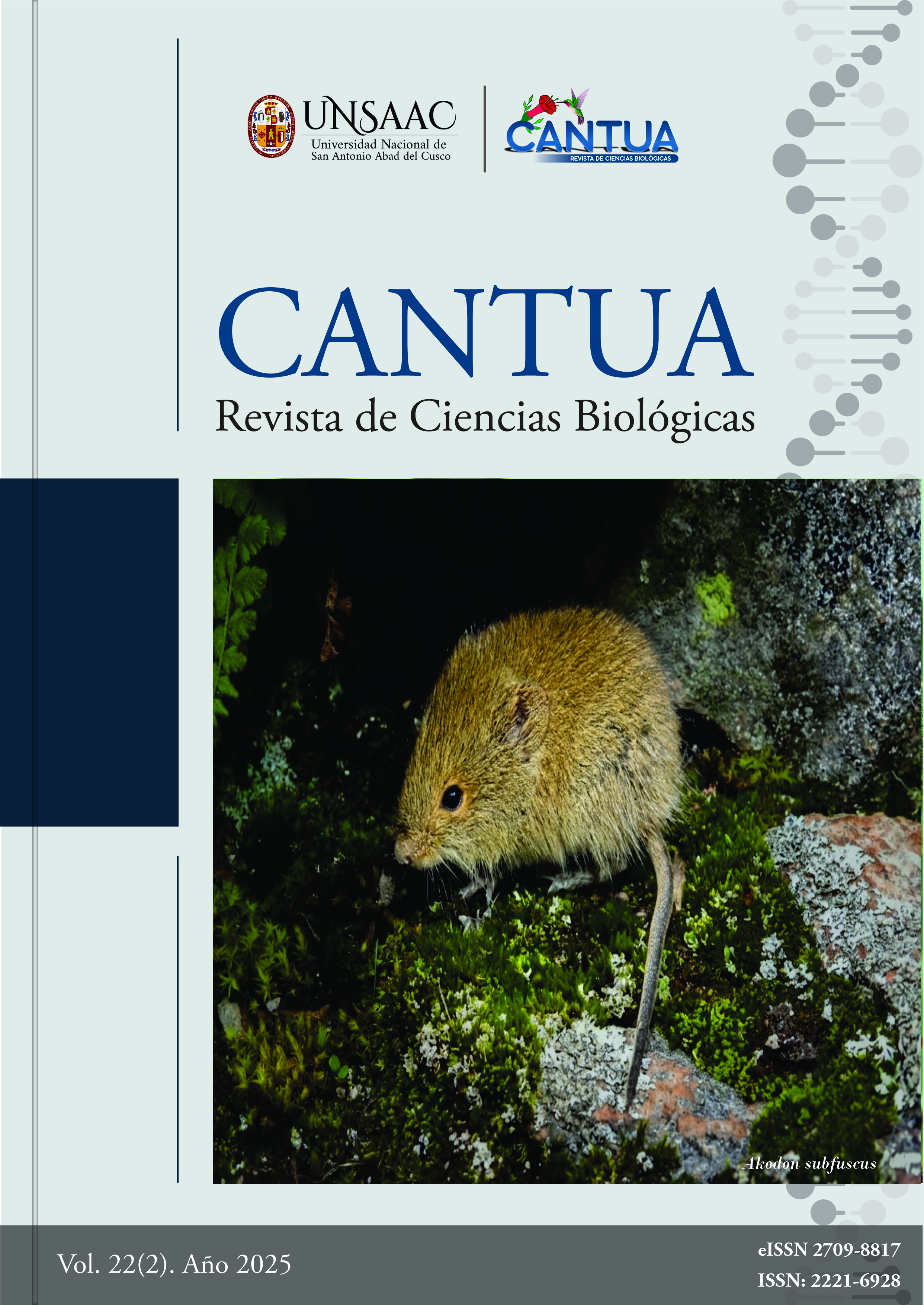
Diversidad y patrones de actividad de las aves en la collpa de guacamayos del río Heath – Parque Nacional Bahuaja Sonene, Madre de Dios, Perú
DOI:
https://doi.org/10.51343/cantu.v22i2.2114Palabras clave:
collpa, cuenca amazónica, Geofagia, Heath, PsittacidaeResumen
Se registra la diversidad y los patrones de actividad de las aves en una collpa en el río Heath en la cuenca amazónica del sureste del Perú. Quince especies de aves hicieron uso de la collpa, loros y guacamayos en su mayoría, y otras 12 especies de aves y 6 de mamíferos también fueron registrados en los alrededores. Las evaluaciones fueron realizadas entre octubre del 2016 a mayo del 2017. Las especies dominantes fueron Ara chloropterus y Eupsittula aurea, esta última conocida en el Perú sólo en el río el Heath. El mayor porcentaje de avistamientos fue en noviembre (21.94%) y marzo (18.10%). Entre las 07:15 y 07:30 horas se registraron hasta 10 especies de aves haciendo uso de la collpa y durante las 09:30 y 09:45 horas se identificó el máximo pico de actividad (n= 742 avistamientos). El uso del recurso (arcilla) en diferentes horas del día, sugiere la segregación de nicho ecológico en estas especies.
Descargas
Citas
Abrahams, P.W. & Parsons, J.A. (1996). Geophagy in the tropics: a literature review. The Geographical Journal, 162:63-72. https://doi.org/10.2307/3060216
Brightsmith, D.J. (2004a). Effects of weather on parrot geophagy in Tambopata, Peru. Willson Bulletin, 116(2): 134-145. https://doi.org/10.1676/03-087B
Brightsmith, D.J. (2004b). Effects of diet, migration, and breeding on clay lick use by parrots in southeastern Peru. Symposium Proceedings, American Federation of Aviculture 2004.
Brightsmith, D.J. (2006). The Psittacine Year: What drives annual cycles in tambopata´s parrots?.VI International Parrot Convention in Loro Parque, Tenerife, Spain.
Brightsmith, D.J. & Aramburú R. (2004). Avian geophagy and soil characteristics in southeastern Peru. Biotropica, 36:534-543.
https://doi.org/10.1111/j.1744-7429.2004.tb00348.x
Brightsmith, D.J. & Villalobos, E.M. (2011). Parrot behavior at a peruvian clay lick. The Wilson Journal Ornithology, 123: 595-602. https://doi.org/10.1676/09-109.1
Burger, J. & Gochfeld, M. (2003). Parrot behavior at a Rio Manu (Peru) clay lick: temporal patterns, associations, and antipredator responses. Acta Ethologica, 6: 23-34. https://doi.org/10.1007/s10211-003-0080-y
Crabtree, D.E. (2007). Factors affecting flight ecology of macaws, parrots and parakeets on the La Torre colpa, rio Tambopata, Peru.
Madre de Dios. Bachelor Thesis. Department of Environmental and Geographical Sciences, Manchester Metropolitan University, Manchester, United Kingdom.
Diamond, J.D., Bishop, K.D. & Gilardi, J.D. (1999). Geophagy in New Guinea birds. Ibis, 141: 181-193. https://doi.org/10.1111/j.1474-919X.1999.tb07540.x
Emmons, L.H. & Stark, N.M. (1979). Elemental composition of a natural mineral lick in Amazonia. Biotropica, 4: 311-313. https://doi.org/10.2307/2387925
Gilardi, J.D. & Munn, C.A. (1998). Patterns of Activity, Flocking, and Habitat Use in Parrots of the Peruvian Amazon. The Condor, 100: 641-653. https://doi.org/10.2307/1369745
Hammer, M.L. (2001). Parrot colpa and geophagy behaviour from the El Gato region of the Tambopata-Candamo Reserved Zone, Amazonia, Peru. Reporte. https://www.biosphere-expeditions.org/images/stories/pdfs/publications/ibis-parrot2001.pdf
Ministerio del Ambiente. (2009). Plan de uso turístico Reserva Nacional de Tambopata (2009-2014). Lima, MINAM.
Klaus, G. & Schmidt, B. (1998). Geophagy at natural licks and mammal ecology: A review. Mammalia, 62(4): 481-497. https://doi.org/10.1515/mamm.1998.62.4.482b
Lovesey, S. (2007). An investigation into the effects of tourist related disturbances on parrot abundance and behaviour at a peruvian geophagy site. Department of Environmental and Geographical Sciences, The Manchester Metropolitan University. Manchester.
Schulenberg, T.S., Stotz, D.F., Lane, D.F., O'Neill, J.P., & Parker III, T.A. (2010). Birds of Peru: Revised and Updated Edition. Princeton University Press.
Smedley, S. & Eisner, T. (1996). Sodium: A male moth’s gift to its offspring. Ecology, 93: 809-813. https://doi.org/10.1073/pnas.93.2.809
Ward, P. & Zahavi, A. (1973). The importance of certain assemblages of birds as “information - center” for food – finding, Ibis, 115: 517-534. https://doi.org/10.1111/j.1474-919X.1973.tb01990.x
Westcott, D.A. & Cockburn, A. (1988). Flock Size and Vigilance in Parrots. Australian Journal of Zoology, 36: 335-349. https://doi.org/10.1071/ZO9880335
Whittaker, R.H. (1965). Dominance and Diversity in Land Plant Communities. Science, 147:250-260. https://doi.org/10.1126/ciencia.147.3655.250
Wink, M., Hofer, A., Bilfinger, M., Englert, E., Martin, M. & Schneider, D. (1993). Geese and dietary allelochemicals? food palatability and geophagy. Chemoecology, 4: 93-107. https://doi.org/10.1007/BF01241679
Zumaran-Rivera, R.J. (2014). Comportamiento de Ara chloropterus (Gray, 1859) en Colpa Colorado, Tambopata, Perú en el periodo octubre 2009-marzo 2010. (Tesis de pregrado) Facultad de Ciencias, Universidad Nacional Agraria la Molina. Lima.
https://repositorio.lamolina.edu.pe/items/373dfdc4-6d6e-433a-a5e7-0c4af1468ef1
Descargas
Publicado
Cómo citar
Número
Sección
Licencia
Derechos de autor 2026 Lourdes Villena, Daniela Susana Olivera Aguirre, Kevin Ibañez Saravia, Jose A. Ochoa

Esta obra está bajo una licencia internacional Creative Commons Atribución-NoComercial 4.0.
-
Eres libre de:
- Compartir : copiar y redistribuir el material en cualquier medio o formato.
- Adaptar : remezclar, transformar y desarrollar el material





.jpg)
.jpg)
.jpg)
.jpg)
_.jpg)